
You’ve found your dream home in Clark County. It has the perfect layout, a great backyard, and a solid roof. But there is one potential deal-breaker you cannot see, smell, or taste.
Radon.
For many homeowners in the Pacific Northwest, radon feels like a ghost story—something scary mentioned in passing, but easy to ignore. However, the geology of Washington State tells a different story. As a local home inspector, the most common question I get is: "Is radon actually a problem here in Vancouver, or is this just an upsell?"
Let’s look at the data, the risks, and why 48 hours of testing can save your health (and your real estate deal).
What Exactly is Radon?
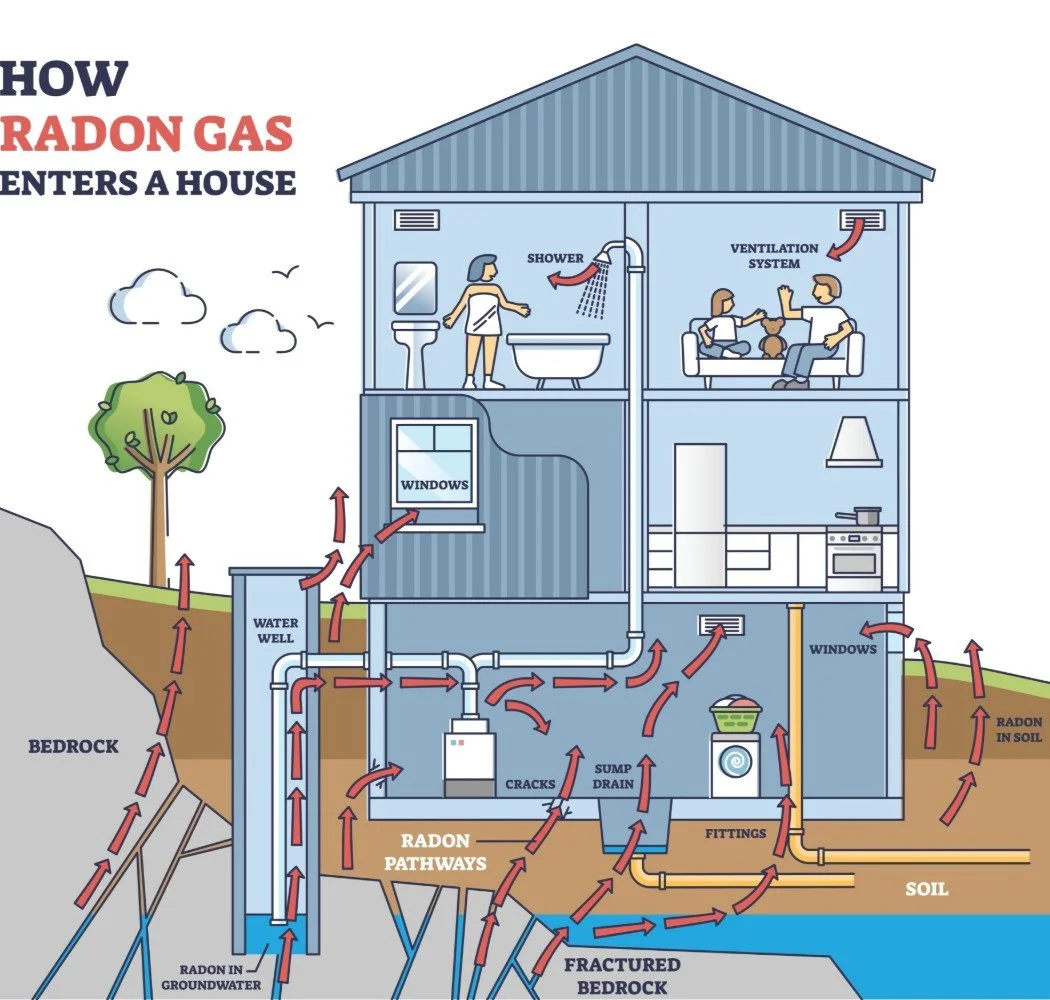
How Radon Gas Enters a House
Radon is a radioactive gas formed by the natural decay of uranium in soil, rock, and water. It moves up through the ground and enters homes through cracks in the foundation, crawl spaces, and utility penetrations.
Because you cannot sense it, radon is often called the "Silent Killer." According to the EPA, it is the leading cause of lung cancer among non-smokers in the United States, responsible for about 21,000 deaths annually.
Are We at Risk? Many people assume radon is only a problem in the Midwest or the Rockies. This is a dangerous misconception.
Clark County is designated as a Zone 1 (High Potential) area by state and federal geologic surveys.
What does this mean for you?
Geology: The glacial deposits along the Columbia River create soil conditions that can release significant amounts of radon gas.
Randomness: Radon is incredibly localized. Your neighbor might test low (safe), while your home tests high (hazardous). You cannot rely on your neighbor's results.
EPA Action Level: The EPA recommends taking action if levels are at or above 4.0 pCi/L (picocuries per liter). We frequently see homes in Vancouver, Camas, and Battle Ground exceed this limit.
"My House is New, So I’m Safe" This is the biggest myth in real estate.
New Construction: New homes are often built explicitly "tight" for energy efficiency. While great for your heating bill, this can trap soil gases inside if the home isn't properly ventilated.
Old Homes: Drafty older homes might naturally ventilate better, but they often have more foundation cracks.
The age of the home does not predict radon levels. The only way to know is to test.
How Testing Works (It’s Easier Than You Think) Fear often comes from the unknown. The testing process is simple and non-invasive:
Deployment: We place a continuous radon monitor in the lowest livable level of the home.
The Wait: The device runs for a minimum of 48 hours, sampling the air hourly to account for day/night fluctuations.
The Results: You get a detailed report showing the average exposure.
What if the Levels are High? Don't panic. High radon is a very fixable problem. If your potential home tests above 4.0 pCi/L, a radon mitigation system can be installed. These systems are effective, typically costing between $2,000 and $3,500—a common point of negotiation during the buying process.
Living in the beautiful Pacific Northwest comes with nature's perks and its quirks. Don't let the invisible risk of radon cast a shadow over your new home.
At iQ Living Solutions, we use calibrated, professional-grade monitors to give you accurate data fast. Whether you are buying a home in Vancouver or just want to ensure your current home is safe for your family, we are here to help.